
Groovy против Котлин

Различия между Groovy против Котлина
Что такое Groovy?
Многие из преимуществ Groovy заключаются в его преобразованиях AST, запускаемых аннотациями. После версии 2 Groovy может быть скомпилирован статически, что позволяет сделать вывод о модели более высокой, чем у Java. Groovy 2.4 остался последним значительным выпуском после спонсорской поддержки Pivotal Software, которая закончилась в марте 2015 года. Groovy 2.5.2 является разработанной надежной версией Groovy. С тех пор Groovy улучшил свою структуру управления до Комитета по управлению проектами в Apache Software Foundation. Возможности Groovy включают поддержку статической и динамической типизации, а также перегрузку операторов, собственный синтаксис для списков, включающих ассоциативные массивы, встроенную поддержку регулярных выражений и несколько языков разметки, таких как XML и HTML. Groovy является управляемым для разработчиков Java после того, как синтаксис для Java и Groovy вполне сопоставимы. Вы можете обрабатывать существующие библиотеки Java, также возможно расширение java.lang.Object.re
Что такое Котлин?
Сравнение лицом к лицу между Groovy и Kotlin (Инфографика)
Ниже представлена основная разница между Groovy и Kotlin. 
Ключевые различия между Groovy и Kotlin
Оба Groovy против Kotlin производительность является одобренным выбором в отрасли. Давайте рассмотрим некоторые заметные различия между Groovy и Kotlin:
Groovy и Kotlin Сравнительная таблица
Ниже приведены основные сравнения между Groovy и Kotlin:
Наконец, это краткое изложение отношений между Котлином и Groovy. Сообщество оказывает значительное влияние, когда дело доходит до новых ярких моментов, и всегда есть предположение, что функция Scala станет частью будущей Java. Несмотря на их различия, они полностью совместимы, что указывает на то, что они могут сосуществовать в одном приложении. Оба, Kotlin vs Groovy, являются языками JVM и являются дружественными для разработчиков.
Рекомендуемая статья
Это было руководство к разнице между Groovy и Kotlin. Здесь мы также обсудим основные различия Groovy и Kotlin с помощью инфографики и сравнительной таблицы. Вы также можете взглянуть на следующие статьи, чтобы узнать больше
Kotlin vs. Groovy: Which Language to Choose

Application of Computer Science to a growing range of fields and general advancements in technologies push programming languages to constant improvement and adaptation to the present-day needs. Now we have a bunch of languages serving different purposes: some of them emerged as an independent project, while others bud off from established and well-known languages.
The colossus of Java, for example, has a number of offspring; some of them have proved to be a success. One of them, Kotlin, was backed by Google as the official language for Android development in 2017 and was reported to be the second most loved and wanted programming language in 2018 Stack OverFlow survey and remains in Top 5 in this year’s survey. Another successful member of Java-based languages is Groovy that is gaining popularity among developers. At the same time, the 2018 Stack OverFlow survey listed Groovy among the most dreaded languages. In this setting, it seems unfair to compare the languages, but let’s see whether Groovy is so dreadful compared to Kotlin and, generally, which of them to choose as another addition to your bag of skills.
Overview
Kotlin
Kotlin is developed by Jetbrains — a company well-known in the Java world for its IDE named IntelliJ IDEA — and open sourced in 2012. It is a high-level, statically typed programming language that runs on Java Virtual Machine (JVM) and can be compiled to JavaScript source code or handle the LLVM compiler infrastructure.
Though internally Kotlin is reliant on the present Java Class library, its syntax may not be specifically compatible with Java. Kotlin has aggressive type inference to decide the type of values and expressions for which type has been left unstated. This makes it less verbose comparing to Java.
Kotlin has a practical mix of features from Java, C# and other new languages. It generally shows many improvements over Java such as null safety or operator overloading, though lacking certain convenient Java properties such as ternary operator and checked exceptions. However, both languages are completely interoperable, so they can co-exist in the same application.
Besides, since Android Studio 3.0 (published in October 2017), Kotlin is also part of the Android SDK and is involved in the IDE’s installation package as an option to the standard Java compiler. The Android Kotlin compiler allows user to target Java 6, Java 7, or Java 8-compatible bytecode.
Kotlin is much appreciated by developers for its interoperability, code security, and accuracy.
Groovy
Groovy is an object-oriented programming language for Java platform that is distributed through the Apache License v 2.0.
The key feature of Groovy is that it aspires to combine the best of two worlds: it supports both static typing typical for Java and more relaxed dynamic typing similar to that of Python.
Moreover, it can be used as both a programming language and a scripting language for the Java Platform. Like Kotlin, Groovy is compiled to Java Virtual Machine (JVM) bytecode and interoperates seamlessly by different Java code and libraries.
Generally speaking, Groovy has a Java-like syntax, but it takes on the ease of more moldable languages, such as Python and Ruby. Groovy can be called a modern Java enhancer, since it provides greater flexibility and introduces special features to applications, such as safe navigation operator (?.), the concept of Closures, Traits, runtime dispatching of methods, Groovy String, Array initialization and many others.
Groovy is a testing-oriented development language with syntax that supports running tests in IDEs, and Java build tools like Ant or Maven. Besides, it provides native support for markup languages like XML and HTML and domain specific languages.
What can also make it attractive to developers is its short learning curve: for Java developers, it is just a step away from the usual syntax, for new learners — it is relatively easy and modern.
Applications
Kotlin
Given the fact that Kotlin as an official Android development language at Google I/O, its most obvious application is Android development.
Speaking more generally, Kotlin is great for developing server-side applications, allowing developers to write concise and expressive code while maintaining full compatibility with existing Java-based technology stacks.
The most prominent applications of Kotlin are rather impressive and include the following giants:
Groovy
Since Groovy is so similar to Java, it is sometimes difficult to find a distinguishing application for it. One thing that is a definite benefit is that Groovy enables to write scripts besides classes, so you can write applications and scripting with the same language. Groovy scripts are a perfect fit for tasks that change often. Since Groovy is a part of JMeter distribution, it is a good idea to use it for scripting and possibly to migrate the scripting logic developed in other scripting languages, to Groovy.
Examples of using Groovy as a scripting language are rather numerous:
1. Netflix uses Groovy for server-side scripting to offer various levels of filtering Besides, Netflix Spinnaker is implemented in Groovy.
2. Oracle’s fusion middleware is using Groovy scripts in its business component suite.
3. LinkedIn use Groovy also in their “Glu” open source deployment & monitoring automation platform.
The other direction of practical applications for Groovy is to use it as an embedded business language (a Domain-Specific Language):
1. National Cancer Institute uses it to do scientific simulations
2. JPMorgan, MasterCard and other financial institutions use Groovy for its nice DSL capabilities.
Syntax
Kotlin
Kotlin is null-safe which is perhaps the most valued feature of Kotlin missing even in Java. Kotlin has two types of references: nullable and non-nullable, so you can compose code by limited NPEs. The null safety feature of Kotlin protects developers from accessing the properties of a null reference.
In Kotlin, every class is a function, and vice versa; besides Kotlin for Android has Optional types, which help with all the safety checkups. A class can be marked as a data class with the standard functionality and utility functions already present.
Kotlin has a lot of other characteristics, like smart casts, ADT (doc), type-safe builders, zero-cost abstractions and, rather importantly, great IDE support.
Groovy
Having no data class, Groovy 1.8 introduced a few alterations which involve,among others, a new class annotation `@Canonical` that is used to create mutable classes. This annotation allows you to write classes in this shortened form and loads all possible combinations of constructors, getters and setters, creating an analogue of the data class.
One of the key features of Groove is Groovy Closures that is an open, anonymous block of code that can take argu Groovyments, return a value and be assigned to a variable. In opposition to the formal definition of a closure, Closure in Groovy can also contain free variables which are defined outside of its surrounding scope that offers a variety of advantages.
Compilation
Kotlin
Kotlin is statically typed language, meaning that the type of a variable should be known at compile-time instead of at run-time.
Groovy
Groovy was created as a dynamic language, so code gets compiled to machine code on the fly while the program is running. Since Groovy 2.0, it is possible to enable static type checking using `@CompileStatic` annotation. It feels nevertheless a little bolted on and does not enforce people to code in a static way. Sometimes even with `@CompileStatic` annotation, Groovy seems to have some dynamic performance remained.
Alternatively, it is possible to designate static typing with the help of a configuration file specifying its name with the — configscript option of the Groovy compiler. It will apply the CompileStatic AST transformation annotation to all source files in the project.
Code Style Settings
Kotlin
One might think that Kotlin as the language developed by a company famous for its intelligens IDEs, will have limitless settings to configure code style. The reality, however, is that the code style settings offered for Kotlin in IntelliJ IDEA are significantly more limited compared to Java. The difference in code style settings is intentional to a degree. The company explains that in their vision they see Kotlin code using consistent coding styles (similar to PEP8 in Python) instead of supporting infinite configuration possibilities.
Groovy
Groovy takes a place somewhere in between Java with its extensive code style settings and Kotlin that has only limited possibilities. As compared to Java, Groovy seems to be 20–25% less flexible in terms of code formatting settings.
Performance
Kotlin
In most cases, Kotlin performance is the same as Java.
Groovy
Groovy even with `@CompileStatic` in most cases is slower than Java or Kotlin due to additional runtime checks and because of Closure which is much more expensive than Kotlin lambda.
Generally speaking, Kotlin and Groovy are both JVM languages and both are developer friendly. Their major difference lies not in syntax, but in compilation. Besides, notwithstanding their differences, they are total interoperable which indicates they can co-exist in the same application.
Some developers agree that Groovy is easier for quick scripts to do something simple or for testing, while Kotlin is a better choice to create something nontrivial without all the friction/ boilerplate of Java and for Android development.
Speaking about future prospective, Kotlin seems to already grant itself a place among Android languages, so mastering it might be a thoughtful decision.
Русские Блоги
Как перенести язык сценариев сборки Gradle с Groovy на Kotlin
Вы можете прочитать эту статью о том, почему вам следует использовать Kotlin DSL для написания скриптов сборки Gradle.Kotlin Meets Gradle
В целом языки Kotlin и Groovy довольно разные, но у каждого есть свои преимущества.
С другой стороны, Groovy очень динамичен по своей природе и, следовательно, очень гибок, но ему не хватает поддержки подходящих инструментов IDE.
Gradle реализован поверх Java JVM, а Groovy DSL и Kotlin DSL реализованы на основе Gradle Java API.
Примечание:
Если вы хотите понять язык Kotlin перед тем, как начать, возможно, вам понадобятся справочные материалы, тогдаСправочная документация Kotlin(Китайский документ) Это то, что вам нужно. И вKotlin KoansПредлагает интересный способ изучения Kotlin, в котором вы можете быстро изучить базовые знания и использование Kotlin.
1. Когда Groovy встречает Kotlin
Язык Kotlin статически типизирован и имеет встроенную защиту от null.С другой стороны, Groovy очень динамичен по своей природе.
Оба DSL предоставляют средства взаимодействия с динамической расширяемой моделью Gradle и средой выполнения.
Используйте Kotlin DSL:
Лучшие практики Gradle, как правило, более декларативны и менее динамичны. Именно в этом Kotlin сияет. В этом смысле Kotlin DSL будет поощрять и продвигать самые лучшие практики Gradle.
Это упрощает применение лучших практик Gradle с помощью Kotlin DSL.
2. Почувствуйте разницу
Сначала мы рассмотрим основное различие между Groovy DSL и Kotlin DSL с точки зрения сценариев.
2.1 Имя файла
Чтобы использовать Kotlin DSL, вам нужно всего лишь build.gradle К build.gradle.kts Вот и все.
settings.gradle Файл также можно переименовать в settings.gradle.kts 。
В многопроектной сборке вы можете использовать Groovy DSL в некоторых модулях (используя build.gradle File), используйте Kotlin DSL в других модулях (используя build.gradle.kts File), поэтому вас не нужно заставлять переносить все одновременно.
2.2 Используйте основные плагины
Использовать plugin Кусок:
Как ты jacoco Как видно из примера, Groovy и Kotlin могут использовать один и тот же синтаксис (за исключением, конечно, двойных кавычек и скобок, которые должны использоваться в Kotlin).
Однако Kotlin DSL также определяет расширенные атрибуты для всех основных плагинов Gradle, поэтому вы можете использовать их напрямую, как показано в примере выше. java 。
Вы также можете использовать более старые apply грамматика:
2.3 Используйте внешние плагины
Все еще использую plugins Кусок:
Старшая apply грамматика:
2.4 Задачи настройки
Ниже будет показано, как настроить jar Единый атрибут задачи:
Однако, если вам нужно только настроить или позвонить Task Вы можете опустить тип атрибутов или методов, объявленных в:
Если вам нужно настроить несколько свойств или вызвать несколько методов в одной задаче, вы можете сгруппировать их в блок следующим образом:
Но есть другой способ настройки задач: использовать Kotlin.Делегированные свойства。
Если вам нужна ссылка на задачу для дальнейшего использования, эта функция будет особенно полезна:
Опять же, если вам нужно выполнить настройку для конкретной задачи, вам необходимо указать тип задачи (например, в этом примере jar )。
Это означает, что иногда необходимо глубже изучить документацию или исходный код настраиваемого подключаемого модуля, чтобы обнаружить типы его настраиваемых задач и импортировать их или использовать их полностью определенные имена.
Это особенно актуально, если вы используете внешние плагины:
2.5 Создать задачу
Задачи можно создавать на tasks Готово на контейнере:
Или прямо в Project Используйте функции API верхнего уровня:
Или с помощью свойства делегата Kotlin, которое очень полезно, когда вам нужно установить ссылку на созданную задачу для дальнейшего использования:
Если вы хотите создать задачу заданного типа (в примере Zip ):
Использовать Project API также может достичь того же эффекта:
Или используйте свойства делегата Kotlin:
2.6 Зависимость и конфигурация
Объявление зависимостей в существующей конфигурации мало чем отличается от Groovy:
Обратите внимание: если вы не используете plugins <> Заблокируйте объявление подключаемого модуля, тогда способ, которым подключаемый модуль должен быть загружен с помощью аксессоров, будет недоступен, и тогда вам нужно будет написать имя напрямую, чтобы решить проблему:
Конечно, благодаря делегированным свойствам Kotlin мы также можем поместить их в область видимости
2.7 Пользовательская конфигурация и зависимости
Иногда нужно добавить свою конфигурацию и добавить к ней зависимости:
2.8 Расширение
Многие плагины можно настроить с помощью собственных расширений. Если эти плагины переданы plugins <> Заблокируйте для объявления, тогда вы можете использовать функции расширения Kotlin для настройки их расширений, как в Groovy.
С другой стороны, если вы все еще используете старую apply Функция для объявления подключаемого модуля (в следующем примере для checkstyle Это относится к плагинам), вы должны использовать configure <> Функция для их настройки:
2.9 От динамического к статическому
Ядро Gradle предоставляет основные строительные блоки модели сборки. Если вы привыкли создавать и писать надстройки, вы можете взаимодействовать с моделью сборки с помощью этих скриптов и подключаемых модулей. Эти взаимодействия включают построение модели сборки. (например, добавление конфигураций, задач или расширений) И настройка элементов модели сборки (конфигурация, задачи, расширения и т. д.).
API Gradle Java позволяет любому языку JVM взаимодействовать с моделью сборки при создании и написании подключаемых модулей. При использовании Java API необходимо запрашивать элементы, предоставляемые подключаемым модулем в модели, в основном имя, тип или и то, и другое.
Помимо Gradle Java API, Gradle DSL предоставляет более лаконичный синтаксис.
Даем каштан. Например, мы создали подключаемый модуль Gradle, реализованный на Java, в котором сначала заявили об использовании distribution Подключаемый модуль, а затем создайте файл с именем samples из distributions И добавим немного общего содержания:
Это многословно, но не зацикливайтесь на нем.
Теперь давайте посмотрим на код, который выполняет ту же функцию, но с использованием Groovy DSL для достижения:
Тогда есть Kotlin DSL:
В двух приведенных выше сценариях автор distributions Подключаемая пара DistributionContainer Тип, предоставляющий расширения, нужно вызывать только по имени. Оба DSL предоставляют структуру для решения расширений элементов модели с помощью подключаемых модулей.
В двух приведенных выше сценариях samples Распределение все в distributions Это набор объектов, созданных и настроенных в расширении, а справка по синтаксису предоставляется как в Groovy DSL, так и в Kotlin DSL.
Есть некоторые отличия, но акцент остается прежним.
3. Стратегия миграции
Механизированная миграция против рефакторинга для получения лучших практик:
Первого достаточно для простых сборок
Сложная и высокодинамичная логика построения потребует некоторого рефакторинга.
Внешние плагины могут не обеспечивать хорошего взаимодействия с Kotlin DSL, вам необходимо найти обходные пути.
Groovy vs Kotlin
By  Priya Pedamkar

Differences Between Groovy vs Kotlin
Groovy is an object-oriented programming language that is based on the Java platform. Groovy 1.0 was released on January 2, 2007, among Groovy 2.4 as the popular, influential release. However, it is distributed through the Apache License v 2.0. It holds both a static and dynamic language, including characteristics related to those of Python, Ruby, Perl and Small talk. It can be used as both a programming language. Moreover, a scripting language for the Java Platform is compiled to J.ava virtual machine (JVM) bytecode, also interoperates seamlessly by different Java code and libraries. Groovy uses a curly-bracket syntax alike to Java’s. Groovy supports closures, multi-line strings, including expressions embedded in strings. Kotlin is a high-level, strongly statically typed programming language introduced by JetBrains, the most intelligent Java IDE’s official designer, named IntelliJ IDEA. Kotlin runs on Java Virtual Machine(JVM). In 2017, Google declared Kotlin is an accepted language for Android development. Kotlin is an open-source programming language that merges object-oriented programming moreover functional characteristics toward a unique platform. The content is classified into several sections that contain associated topics, including manageable, furthermore beneficial examples. Kotlin is the latest open-source programming language similar to Java, Scala, Groovy, Gosu, JavaScript, etc. The syntax of Kotlin may not be specifically related to JAVA; nevertheless, internally, Kotlin is reliant on the present Java Class library to generate excellent outcomes for the developers.
What is Groovy?
Many of Groovy’s strength lies in its AST transformations, triggered by annotations. After version 2, Groovy can be compiled statically, allowing model inference furthermore performance near that of Java. Groovy 2.4 remained the latest significant release following Pivotal Software’s sponsorship which ended in March 2015. Groovy 2.5.2 is the developed durable version of Groovy. Groovy has since improved its governance structure to a Project Management Committee in the Apache Software Foundation. Features of Groovy support both static and dynamic typing, operator overloading, the Native syntax for lists including associative arrays, Native support for regular expressions, and several markup languages such as XML and HTML. Groovy is manageable for Java developers after the syntax for Java and Groovy are quite comparable. You can handle existing Java libraries also possible to extend the java.lang.Object.re
Web development, programming languages, Software testing & others
What is Kotlin?
Kotlin gives interoperability, code security, plus accuracy to programmers throughout the world. Kotlin can be compiled to JavaScript source code either handle the LLVM compiler infrastructure. Its fundamental development is of a team of JetBrains developers based in Saint Peters burg, Russia. While the syntax is not cooperative with Java, the JVM implementation of the Kotlin official library is composed to interoperate among Java code also; it is reliant on Java code from the current Java Class Library, such as the models’ framework. Kotlin practices aggressive model inference to decide the type of values plus expressions for which type has been moved unstated. This decreases language wordiness related to Java, which usually necessitates uniquely redundant type specifications prior to version 10. As of Android Studio 3.0 (published in October 2017), Kotlin is entirely maintained by Google for use among their Android operating system; moreover, it is undeviatingly involved in the IDE’s installation package as an option to the standard Java compiler. The Android Kotlin compiler allows the user to decide within targeting Java 6, Java 7, or Java 8-compatible bytecode.
Head To Head Comparison Between Groovy and Kotlin (Infographics)
Below is the top difference between Groovy vs Kotlin
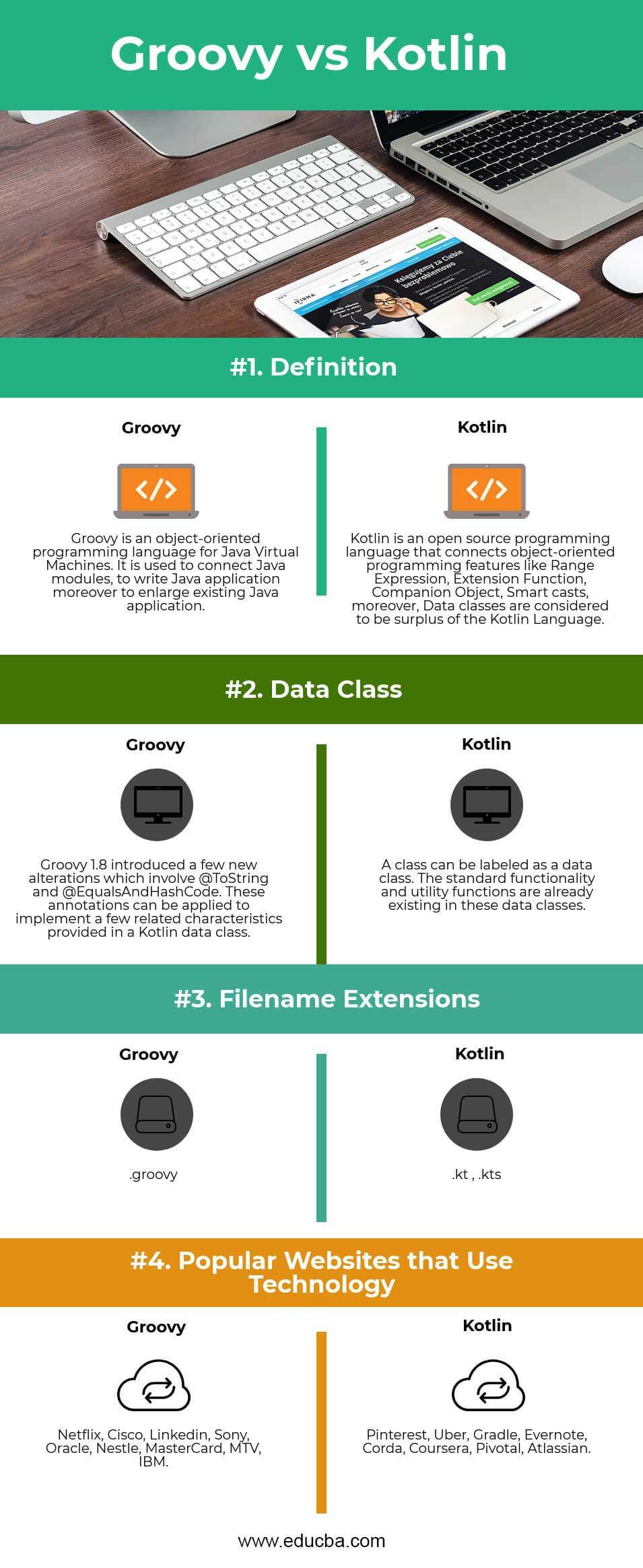
Key Differences Between Groovy and Kotlin
Both are approved choices in the industry. Let us consider some of the notable difference:
Groovy vs Kotlin Comparison Table
Below is the topmost comparisons:
Conclusion
Conclusively, it’s a summary of the relationship between Kotlin vs Groovy. The community has a significant impact when it comes to new highlights, and there’s always to assume that a Scala feature will become part of future Java. Notwithstanding their differences, they are total interoperable, which indicates they can co-exist in the same application. Both, Kotlin vs Groovy are JVM languages and are developer-friendly.
Recommended Article
This has been a guide to the top difference between Groovy vs Kotlin. Here we also discuss the Groovy and Kotlin key differences with infographics and comparison table. You may also have a look at the following articles to learn more.
Java Training (40 Courses, 29 Projects, 4 Quizzes)